Consultant Fee Calculator
💼 Consultant Fee Calculator SaaS · pro
Consultant Fee Calculator: Set your ideal consulting rates — hourly, daily, weekly, monthly — based on your income goals and business costs.
Revenue goal progress
Consultant Fee Calculator Guide 2026
Introduction: What is a Consultant Fee Calculator?
A Consultant Fee Calculator is an essential tool for independent consultants, freelancers, business advisors, and professional services providers. As crucial as calculating the right fee is choosing the right pricing model. A Consultant Fee Calculator gives you an indicative fee, but your pricing model dictates how you’ll charge clients, and how predictable your income will be.
Good consultants use more than just one pricing system. Rather, they decide on the model which best fits the nature of the project, client requirements and business goals. Understanding both the consulting rates and the pricing model is key to building a sustainable consulting business.
1. Hourly Pricing Model for Consultants
One of the most popular practices is to charge hourly consulting rates, particularly for newer consultants and temporary contracts.
Best for:
- One-time consultations
- Advisory sessions
- Troubleshooting
- Small business clients
- Projects where there isn’t a clear scope
Advantages:
- Easy to calculate
- Client understands pricing
- Suitable for flexible projects
- Ensures that the scope does not change
Disadvantages:
- There will be a limit on the number of hours which is used to define income
- Clients may choose to consider time rather than value
- Less scalable than project based pricing
Example Formula:
Hourly Rate = (Desired Annual Income + Business Expenses + Taxes) / Billable Hours
For example:
- Desired income: $100,000
- Annual expenses: $25,000
- Taxes and savings: $25,000
- Billable hours: 1,250
Hourly consulting rate:
$150,000 ÷ 1,250 = $120/hour
2. Daily Rate Pricing for Consultants
Many seasoned consultants prefer a day rate as opposed to an hourly fee. A consulting day is around 6–8 hours billable.
Benefits:
- Easier proposal creation
- Simplifies client budgeting
- Encourages productivity instead of time tracking
Formula:
Daily Rate = Hourly Rate × 8
So if you charge $125 per hour, you will get an estimated daily rate of:
**$1,000/day**
3. Fixed Project Pricing Model
Project-based pricing means that you’re paying a flat fee for the project regardless of the amount of time it takes. It’s a good pricing structure if project requirements are well defined.
Ideal for:
- Marketing strategies
- Website audits
- Business plans
- Process improvement
- HR consulting
- Financial consulting
Advantages:
- Predictable income
- A better way for clients to budget for their project
- Rewards efficiency
- Higher profit potential
Challenges:
- Needs to have a well-defined project scope
- If not managed properly, scope creep may diminish profit
4. Monthly Retainer Pricing Model
The majority of proven consultants earn regular income through a monthly retainer. Clients pay a monthly fee for ongoing support.
Typical services include:
- Strategic consulting
- Executive coaching
- Marketing consulting
- Technology advisory
- Fractional leadership
- Compliance support
Benefits:
- Consistent cash flow
- Long-term client relationships
- Better financial forecasting
- Decreased resources used for prospecting new clients
5. Value-Based Pricing Model
Value-based pricing is about the results produced instead of hours worked.
Instead of asking: “How much time is required for this?”
Ask: “What business value will this bring?”
For example: If your recommendations are able to save a company $500,000 per year, your $25,000 charge might be a great investment for the client!
Experienced consultants use this pricing approach because in this way, progress towards the results is priced, thus reflecting expertise and measurable results.
Consultant Pricing Models Comparison Table
| Pricing Model | Best For | Pros | Cons |
|---|---|---|---|
| Hourly | Short projects | Easy to calculate | Limited earning potential |
| Daily | Workshops and advisory work | Simple pricing | Less flexible for partial days |
| Fixed Project | Clear functional outcomes | Stable income | Project definition is important to success |
| Monthly Retainer | Ongoing support | Consistent financial cash flow | Greater demands from clients |
| Value-Based | High-impact projects | Highest profit potential | Requires credible results and high impact |
How to Calculate Consulting Fees Using a Consultant Fee Calculator
A Consultant Fee Calculator is most effective when used in conjunction with a structured pricing process. Here’s a step-by-step guide:
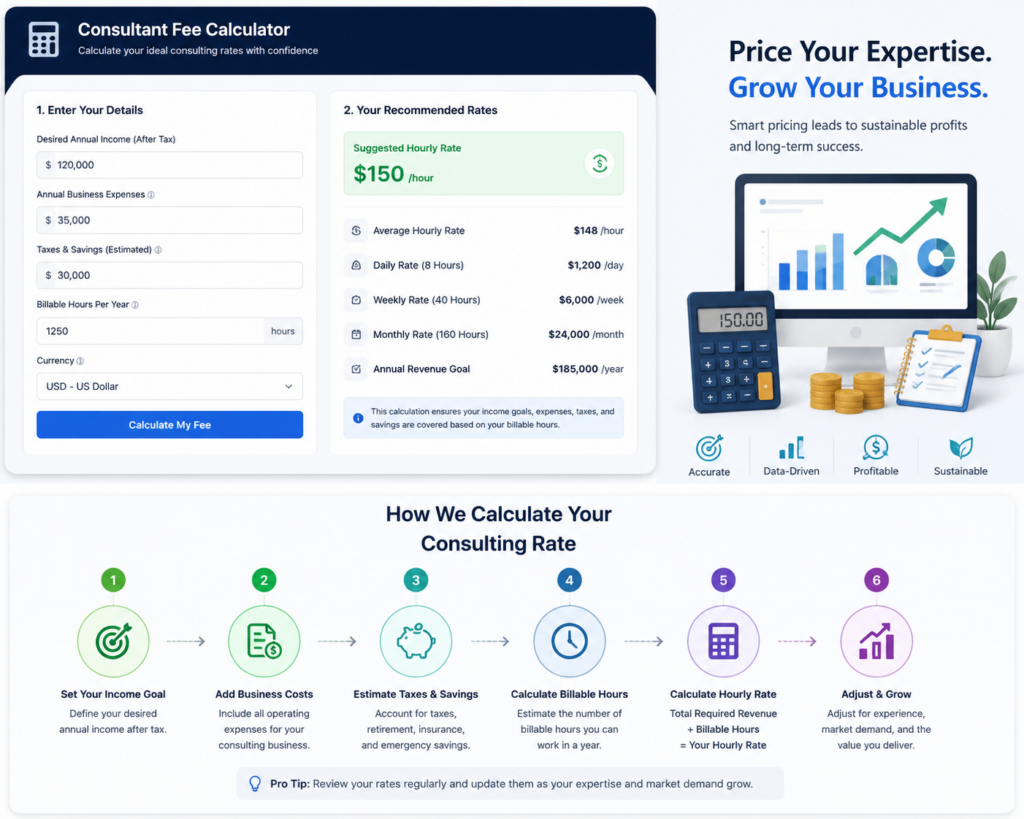
Step 1: Set Your Income Goal
The first step is to determine your desired annual income.
Example: $120,000
Step 2: Add Business Costs
Add in regular costs like:
- Software subscriptions
- Professional insurance
- Website hosting
- Marketing campaigns
- Training and certifications
- Office equipment
- Travel expenses
- Accounting services
Example: Annual expenses: $35,000
Step 3: Estimate Taxes and Savings
Remember to include:
- Income taxes
- Retirement contributions
- Emergency reserves
- Paid vacation
- Health insurance
Estimated total: $30,000
Step 4: Calculate Billable Hours
Consultants work about 2,000 hours per year, and only 50–70% of that time is considered billable.
Example:
- Working hours: 2,000
- Billable hours: 1,250
Step 5: Determine Your Minimum Hourly Rate
Formula:
($120,000 + $35,000 + $30,000) ÷ 1,250 = $148/hour
For easier quoting, round up to $150/hour.
Step 6: Consider Experience and Market Demand
If you provide the following, increase your calculated rate:
- Specialized expertise
- Industry certifications
- Proven case studies
- Exceptional client outcomes
- High-demand niche services
Consultant Fee Calculator Example Table
| Category | Amount |
|---|---|
| Desired Annual Income | $120,000 |
| Business Expenses | $35,000 |
| Taxes & Savings | $30,000 |
| Total Required Revenue | $185,000 |
| Billable Hours | 1,250 |
| Average Hourly Rate | $148/hour |
| Suggested Hourly Rate | $150/hour |
Common Consultant Pricing Pitfalls to Avoid
Even experienced professionals can make avoidable pricing mistakes that can jeopardize profits.
Charging Too Little
Too many new consultants compare themselves to competitors rather than calculating sustainable rates.
Low pricing can:
- Reduce perceived value
- Attract price-sensitive clients
- Limit business growth
- Cause financial stress
Copying Competitor Pricing
Each consulting firm is unique in many ways:
- Expenses
- Experience
- Skills
- Target market
- Value proposition
Your prices should not be based on another company’s business model; they should be based on your own.
Ignoring Business Costs
Some common costs that are not obvious:
- Software renewals
- Taxes
- Marketing
- Proposal development
- Administrative work
- Continuing education
These expenses may not be included, or your consulting fee may not cover your operating costs.
Being Unable to Raise Rates
The more knowledgeable you become, the more you should adjust your prices. Check your rates every year or when you make an important milestone such as:
- Completing major projects
- Earning new certifications
- Expanding service offerings
- Showing quantitative data of client results achieved
Not Defining Project Scope
Lack of clear scope boundaries frequently leads to scope creep—more work asked for without more pay. All proposals must include:
- Deliverables
- Timelines
- Revision limits
- Payment terms
- Out-of-scope work
Clear agreements benefit you, your client, and your project profitability.
Industry-Specific Consulting Rates
Consulting fees vary considerably across different industries, depending on demand, specialization, project complexity, and value added to the client. You can start with a Consultant Fee Calculator, but you can use market benchmarks to validate your pricing.
The following numbers are only general estimates and should be adjusted based on your experience, geographic area, certifications, and clientele.
Industry-Specific Consulting Rate Table
| Industry | Typical Hourly Rate | Common Pricing Model |
|---|---|---|
| Business Consulting | $100–$300 | Hourly or Project |
| Marketing Consulting | $75–$250 | Project or Retainer |
| IT Consulting | $100–$350 | Hourly or Project |
| Cybersecurity Consulting | $150–$400 | Project |
| HR Consulting | $80–$250 | Hourly or Retainer |
| Financial Consulting | $120–$400 | Project |
| Management Consulting | $150–$500+ | Value-Based |
| Healthcare Consulting | $120–$350 | Project |
| Legal Consulting | $200–$600+ | Hourly |
| AI & Data Consulting | $150–$500+ | Value-Based |
Note: The ranges are guidelines, not rules. A proven track record of providing measurable business results, expertise, or skills might justify higher rates for consultants.
Advanced Consultant Pricing Strategies
If you’ve determined a base rate that you can sustain with a Consultant Fee Calculator, the next step is to fine-tune your pricing strategy. Price isn’t simply a reflection of costs; it’s a reflection of value added and a method for business growth.
1. Value-Based Pricing Strategy
Value-based pricing puts your price on where your business impact lies, not on the hours you devote.
For instance, if your recommendations bring in an additional million dollars per year in income for your client, charging $40,000 is a great return on investment.
This model is most effective if:
- Results are measurable
- You have a very niche skill
- Clients expect results, not hourly fees
- You have documented success stories and case studies
2. Tiered Pricing Packages
Don’t provide just one option – make several packages to accommodate clients with varying budgets and needs.
Basic Package:
- Initial consultation
- Assessment report
- One strategy session
Professional Package:
- Full business analysis
- Strategic recommendations
- Implementation roadmap
- Follow-up meeting
Premium Package:
- Comprehensive consulting
- Implementation support
- Team training
- Monthly progress reviews
- Ongoing advisory access
Tiered pricing provides flexibility for clients while boosting your project average value.
3. Performance-Based Pricing
Some consultants charge a flat fee plus performance-based incentives.
Examples include:
- Sales growth bonuses
- Cost-saving incentives
- Revenue-sharing agreements
- Performance milestones
This shows confidence in your abilities and aligns your success with your client’s objectives.
4. Retainer Plus Project Fees
An experienced consultant might have a retainer fee in addition to project fees.
For example:
- Monthly strategy meetings
- Email and phone support
- Quarterly planning sessions
- Additional fees for special projects
This hybrid model offers steady income while enabling you to charge for larger projects.
How to Boost Your Consulting Income Without Losing Clients
While it may be difficult to get some clients to agree to a raise, many will do so as long as it’s done right and they feel they are getting value from you.
Demonstrate Measurable Results
When you can demonstrate results like these, your clients will be more willing to pay more:
- Revenue growth
- Cost reductions
- Productivity improvements
- Increased customer satisfaction
- Operational efficiencies
Use real data and case studies to quantify results as much as possible.
Develop a Personal Brand
A good reputation commands higher prices. To build your brand:
- Publishing educational content
- Writing articles for the press
- Appearing on podcasts
- Teaching workshops
- Earning respected certifications
A well-known adviser with strong credentials may earn more than another top-notch consultant with little visibility.
Choose a Specialized Niche
Generalists tend to compete on price more than specialists.
Examples of high-value consulting niches:
- Artificial intelligence implementation
- Cybersecurity
- Regulatory compliance
- Digital transformation
- Healthcare operations
- Executive leadership coaching
Specialization can make you the go-to professional for specific business problems.
Improve Client Experience
Outstanding service results in repeat and referral business. Focus on:
- Clear communication
- Timely responses
- Well-organized proposals
- Transparent pricing
- Consistent project updates
- Professional reporting
A client might recall the whole experience as much as the technical knowledge.
Frequently Asked Questions (FAQs)
How do you determine consulting fees?
Answer:
To determine consulting fees:
- Calculate the annual income you want to make
- Add business expenses, taxes, and savings
- Estimate your annual billable hours
- Calculate your needed income per hour
- Adjust based on your knowledge, skill level, market demand, and the value you are adding
This enables you to set a sustainable rate for your consulting services and still make a profit.
What is the optimal pricing model for consultants?
Answer:
It really depends on your work and what the best model would be:
- Hourly pricing for advisory sessions and small projects
- Project-based pricing when the work is well-specified
- Monthly retainers for ongoing consulting relationships
- Value-based pricing for measurable business results
Many successful consultants use a combination of pricing models to serve different clients’ needs.
Why is a consultant fee calculator essential?
Answer:
A consultant fee calculator is essential because it helps you make better business decisions. It can help you:
- Forecast annual revenue
- Plan business growth
- Evaluate profitability
- Compare pricing scenarios
- Prepare professional proposals
- Set achievable financial goals
- Make informed decisions on pricing
- Enhance negotiating confidence with clients
Instead of shooting in the dark, you can base your fees on data from your business and your strategic goals.
Why do clients believe in well-priced consultants?
Clients don’t only seek competitive pricing but also assurance that their investment goes into something reliable. Ways to increase client trust:
- Having relevant industry experience
- Using client testimonials
- Providing demonstrable business results
- Being transparent about pricing
- Sharing information on your consulting approach
- Staying educated through professional development and certification
An effective pricing strategy, combined with evidence of expertise and solid client results, will add to your credibility.
What’s a Consultant Fee Calculator?
A Consultant Fee Calculator is like a cheat sheet for setting your prices. It takes all the guesswork out. Just type in your income goals, business expenses, taxes, how many hours you actually want to work, your experience, and the results you deliver. Instead of guessing your rates, you get a concrete system to set prices that actually work for your business—and keep things sustainable.
How do you figure out your consulting hourly rate?
Here’s a straightforward way:
- Decide what you want to make in a year
- Add up all your business costs and taxes
- Figure out how many hours you’ll truly bill clients for
- Add your income goal and expenses together, then divide by your billable hours
- Adjust your number—bump it up if you have rare skills, strong demand, or a track record for big results
That’s how you set a rate that’s about more than just barely scraping by.
Should you charge by the hour or by the project?
It depends on how you work, who your client is, and what the job looks like:
- Hourly rates for advice, coaching, or anything open-ended
- Project rates when there’s a clear scope and deadline
- Retainers when your client wants you around for the long haul
- Value-based pricing when you deliver results that change the game
Most consultants end up mixing these methods depending on what’s needed.
What affects your consulting fees?
Several factors stack up here:
- How specialized your field is
- How much experience you’ve got
- Any certifications or unique skills you bring
- Where you live—and where your clients are
- How complex the project is
- The size and budget of your client
- Your own running costs
- Demand for what you do
- Real results or impact you deliver
It’s smart to check your rates now and then, so they keep up with your growing business and the market.
How often should you revisit your rates?
Once a year is a solid starting point. But anytime you:
- Finish a big, impressive project
- Pick up new skills or certifications
- Add new services
- Land bigger clients
- Score clear, measurable wins
That’s your signal to review—and probably raise—your rates. Let your rates grow as you do.
Can beginners use a Consultant Fee Calculator?
Absolutely. It doesn’t matter if you’re just starting out or already a pro. If you’re new, it saves you from undervaluing yourself. If you’re experienced, it helps you fine-tune your fees as your business or industry shifts.
Key Takeaways
A Consultant Fee Calculator isn’t just about crunching numbers. It’s a strategic tool to make sure your rates actually work for your life and your level of expertise.
Remember:
- Base your rates on what you really need—don’t just copy someone else’s pricing
- Include every cost, taxes, and non-billable time
- Match your pricing style to each project and client
- Update your rates as your results and reputation grow
- Show your value—real results and happy clients back up your prices
- Spell things out clearly in your proposals
- Your results drive your rates. Nothing beats proof.
Final Thoughts
Your prices matter—more than most people admit. Charge too little, and you’re working yourself into the ground. Make up numbers, and clients lose faith.
A Consultant Fee Calculator gives you something real to stand on. Whether you’re solo, freelancing, or part of a team, you’ll spend less time second-guessing and more time enjoying a healthy, stress-free business.
Keep checking in on your rates. Celebrate your value by making sure your fees reflect it. When you combine thoughtful pricing, great service, and transparency, you build trust, keep clients coming back, and actually enjoy building your business.
Conclusion
Setting your price shouldn’t be guesswork. A Consultant Fee Calculator roots your rates in reality—what you need, what you bring to the table, and how you work. If you match your pricing to each client and project, you’ll feel confident every time you send a quote.
In the end, clients pay for expertise and results, not just hours. Keep your pricing sharp, pay attention to the value you deliver, and always look for ways to improve. That kind of strategy brings better clients, bigger profits, and a business that keeps moving forward—wherever you are on your journey.
Recommended Resources
Professional Consulting Resources:
- Consultants Mind – Professional Consulting Resources
- ICO Council – International Consulting Organization
- Consulting.com – Consulting Business Training